The Centaurus A Radio Galaxy
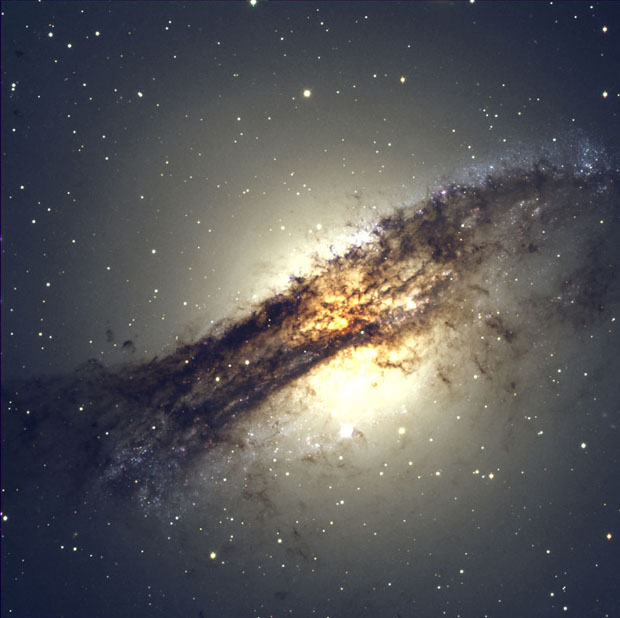
From The European Southern Observatory
Centaurus A (NGC 5128) is one of the foremost examples of a
radio-loud active galactic nucleus (AGN). On images obtained at optical
wavelengths, thick dust layers almost completely obscure the galaxy's center.
This structure was first reported by Sir John Herschel in 1847. Until 1949,
NGC 5128 was thought to be a strange object in the Milky Way, but it was
then identified as a powerful radio galaxy and designated Centaurus A.
The distance is about 10-13 million light-years (3-4 Mpc) and the apparent
visual magnitude is about 8.
Centaurus A is a merger of an elliptical with a spiral galaxy
as elliptical galaxies would not have had enough dust and gas to form the
young, blue stars seen along the edges of the dust lane. The core of Centaurus
A is the smallest known extragalactic radio source, only 10 light-days
across. A jet of high energy particles from this center is observed in
radio and X-ray images. The core probably contains a supermassive black
hole with a mass of about 100 million solar masses. Note the great number
of massive and luminous blue stars that are well resolved individually,
in the upper right and lower left .
The composite image is based on three exposures through different
optical broadband filters (B: 429 nm central wavelength; 88 nm FWHM (Full
Width at Half Maximum), V: 554/111 nm, R: 655/165 nm). All were taken with
the 2048 pixel x 2048 pixel CCD detector with a field of view of 6.8 arcmin
x 6.8 arcmin; each pixel measures 24 µm square. North is up and East
is left.
Based on press release with ESO PR Photo 05b/00
Catalog #: Photo 05b/00
Target Name: The Centaurus A Radio Galaxy
Back to galaxy index.
Back to main index.
© Copyright 2000 Outreach Consortium. All Rights Reserved.
Last Modified On: Saturday, December 16, 2000